
Accelerators

Panacea Test
Panacea Test is a distributed, full-stack, end-to-end system validation platform built by Zimetrics. It enables high-fidelity verification of stateful system behaviors that stretch across APIs, databases, integration platforms, mobile apps, cloud services, application software, embedded firmware, and human touchpoints.
By unifying Hardware-in-the-Loop, Software-in-the-Loop, and Digital Twin testing under one orchestration layer, Panacea closes the gap between hardware and software validation teams and significantly reduces the time required to deliver regulated, high-quality products to market
Fast-moving teams with a wearable, an implantable, or a connected diagnostic, paired with a mobile app and cloud backend. You need to move at sprint velocity without losing the audit trail required for FDA or CE submission

Established device makers with imaging, dialysis, infusion, or therapy portfolios trying to layer modern software experiences onto a hardware-first V-model. You need a validation platform that respects your hardware processes while accelerating your software ones

Teams building complex systems where software latency must be validated against real-time physical movement, and where every test result is potential evidence in a safety case.
If you build a connected medical device, you live with a methodology trap. Your software team wants to ship in two-week sprints with CI/CD. Your hardware and regulatory teams operate on a V-model timeline of physical prototypes, formal reviews, and documentation crunches. The result is predictable and painful.
Most testing tools are good at one layer. UI tools handle the screen. API tools handle the network. Hardware test rigs handle the device. The trouble starts when a single user scenario crosses all of them at once, and your teams have to manually correlate logs from four different consoles to find out why a feature broke
Nine integrated capabilities, designed for connected hardware-software ecosystems and ready for production use from day one

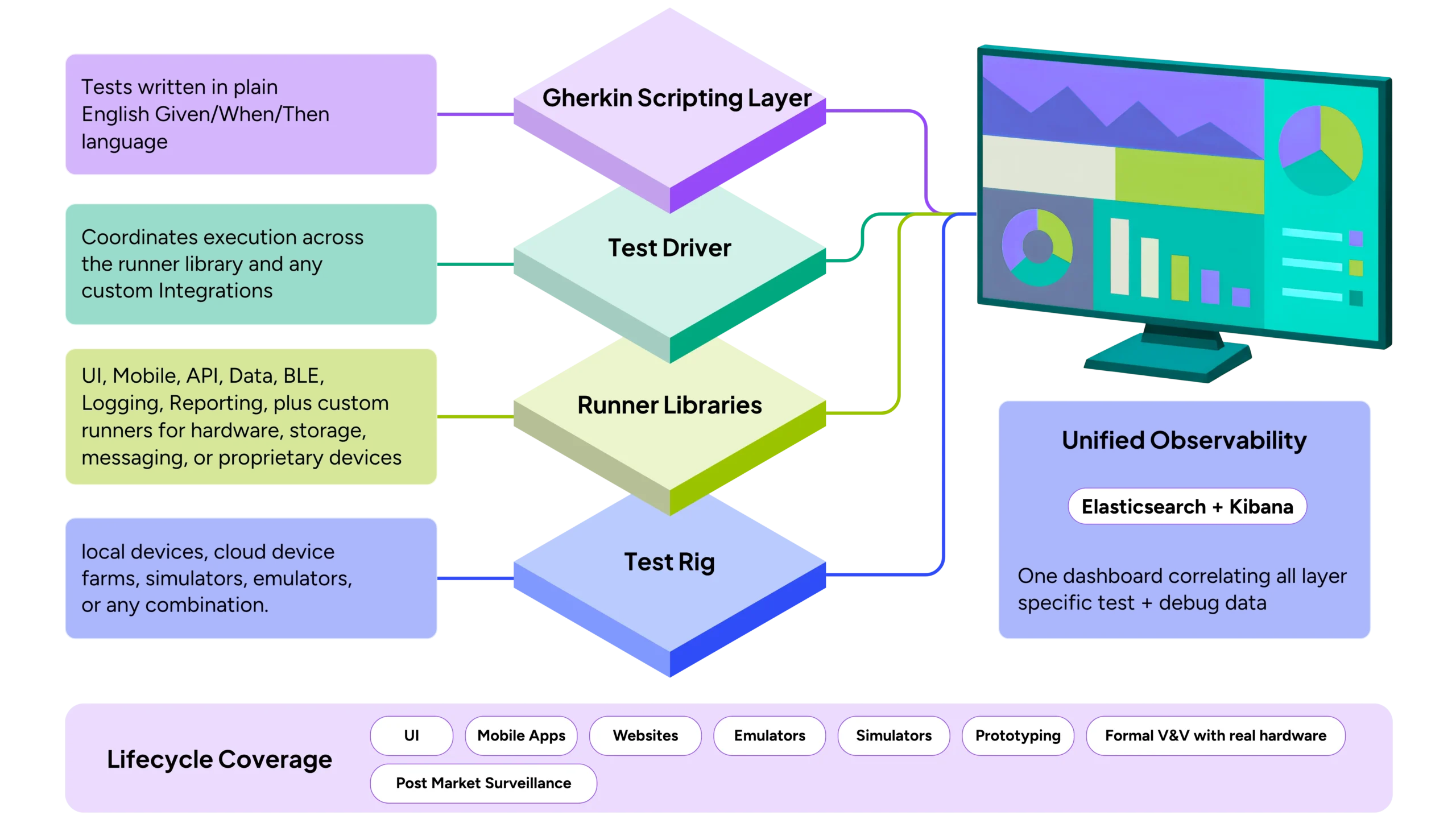
A single test script can drive a web UI, a mobile app, an API gateway, a database, a simulator, and a physical device concurrently. No more stitching together four different runners to verify one user journey

First-class support for HIL, SIL, and Digital Twin scenarios. Drive real devices over BLE, USB, serial, or Ethernet. Stub them out with high-fidelity simulators when the physical lab is busy. Switch between modes without rewriting tests

Every test run captures application logs, API request and response payloads, BLE packet traces, firmware logs, oscilloscope captures, and database state. Correlated views in Elasticsearch and Kibana enable root-cause analysis a matter of minutes, not days

Deploy on EC2, scale with Auto Scaling Groups, store artifacts in S3, monitor with CloudWatch, analyze with OpenSearch, and run mobile tests on AWS Device Farm. Hybrid on-prem deployments are fully supported for lab and HIL settings

AWS IAM for access control, KMS for encryption at rest, audit-ready test evidence, and architectural alignment with the documentation expectations of regulated sectors including medical, automotive, and industrial IoT

Panacea uses Gherkin so business analysts, QA engineers, and regulatory reviewers can read and write tests in plain Given-When-Then language. Test cases double as living specifications

Pre-engineered runners for UI, API, Mobile, Database, BLE, and embedded hardware ship out of the box. Build custom runners for any proprietary protocol, oscilloscope, signal generator, or domain-specific tool using a documented framework

Logical assertions, visual regression, reference-based comparisons, and Quality-of-Service measurements (packet drops, latency, reconnect time) are all first-class test outcomes

Plug into Jenkins, GitHub Actions, GitLab, or Azure DevOps pipelines. Sync test results, defect linkage, and traceability to Jira, Xray, and TestRail so the Design History File and Verification Matrix stay current with every commit
Most teams already own an ALM, a defect tracker, a UI automation tool, and probably a hardware test rig from the likes of National Instruments or Vector. Each of those tools is excellent at what it does. None of them was designed to run a single end-to-end scenario across all of them at once. That is the gap Panacea fills.
Three differentiators that matter
Panacea is the only platform that lets a single Gherkin scenario talk to a mobile app, a cloud database, and a physical hardware sensor at the same time, with synchronized diagnostics from every layer. Competing tools either focus on one layer or require complex custom glue code to coordinate.
Panacea is an accelerator that sits on top of open-source tools (Robot Framework, Playwright, Selenium, Appium, REST Assured). You are not locked into proprietary scripting languages or per-seat fees from a single vendor. Your team’s existing skills transfer directly
Traceability matrices and test evidence artifacts are generated automatically as a byproduct of test execution. Instead of a multi-week documentation crunch at the end of every release, the regulatory record updates continuously with every passing test run
The technical capabilities translate into concrete business outcomes that matter to engineering leaders, program directors, and quality heads.
Parallel execution and full-stack orchestration cut verification cycles dramatically. Customers have reduced execution time by up to 60 percent and reached 80 percent plus automation coverage
Catch integration defects in the build pipeline, not in pre-market clinical evaluation. Every commit is verified against the full system, including hardware, before it merges
Every test run produces structured, timestamped, traceable evidence ready for FDA, MDR, IEC 62304, and ISO 13485 review. No more reverse-engineering documentation at submission time
Open-source foundations mean no per-seat licensing for the core test engine. Reusable runners and BDD scripts mean test assets compound in value across product lines rather than being thrown away each release
When both teams share a single test orchestration platform, the same scripts, and the same diagnostics, the historical friction between Agile software and V-model hardware disappears
Start with a three-device HIL bench in your dev lab. Scale to a multi-tenant cloud device farm for formal V&V campaigns. The test scripts and the platform remain the same
Panacea is built on a familiar, open-source foundation (Robot Framework, Playwright, Selenium, Appium, and REST Assured) with a unified Gherkin orchestration layer on top. A tester can describe a complete user journey in plain Given-When-Then language and have Panacea execute it concurrently across web, mobile, API, database, BLE hardware, and cloud services.
Panacea is cloud-deployable on AWS, supports hybrid deployments alongside on-premise device farms, and is designed for regulated industries where evidence, traceability, and reproducibility are not optional.
Talk to us about your connected device program. We will walk you through Panacea live, against a scenario from your product, and show you exactly how it would fit into your existing toolchain, CI/CD pipeline, and regulatory framework.
What you can expect from the conversation: